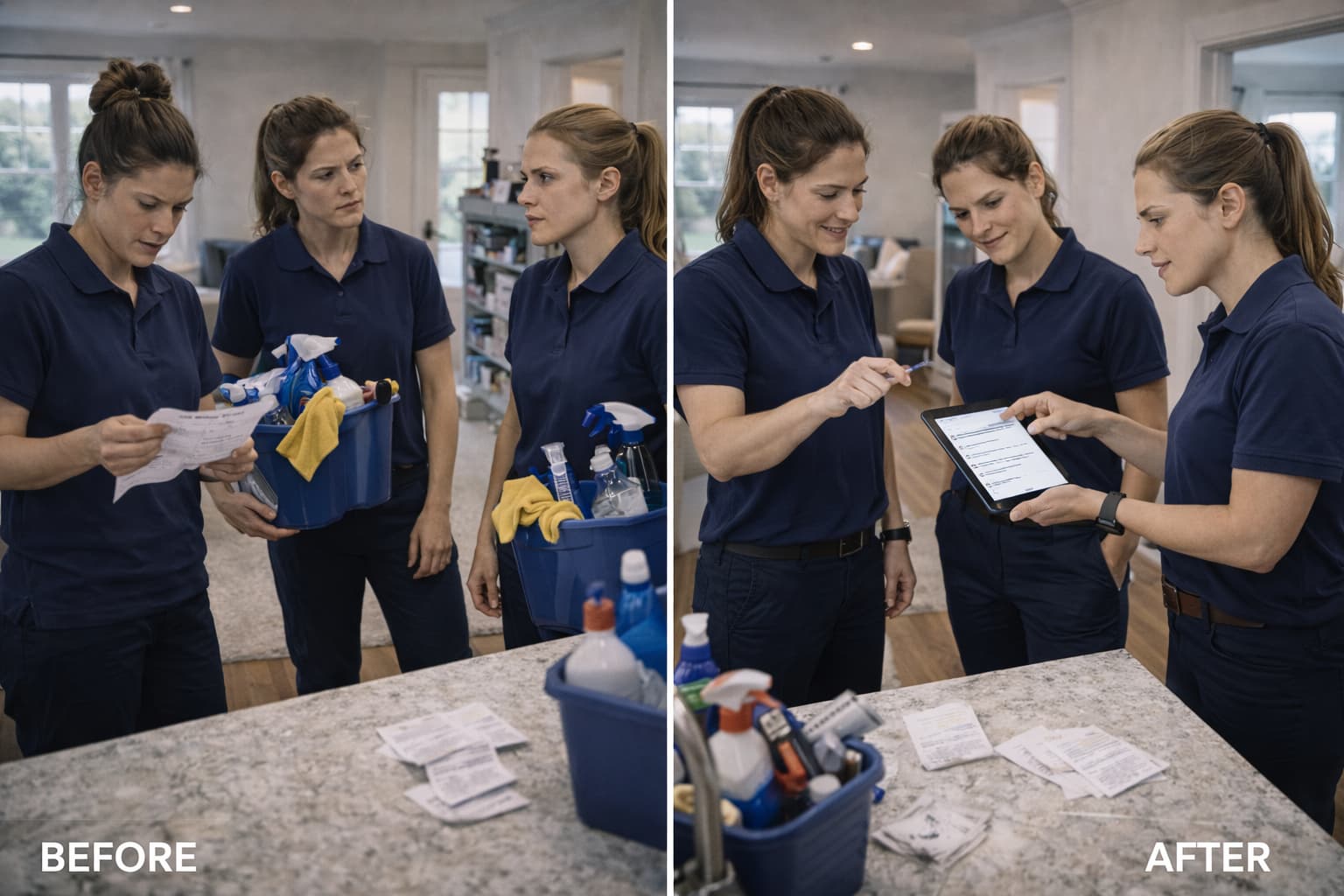
Cleaning pricing mistakes: scope, time and the wrong denominator
Check the assumptions behind a cleaning quote before using discounts, competitor rates or a margin target.
THE SHORT ANSWER
Pricing errors often begin before the price is written: unclear scope, understated labor input, missing travel or an incorrect margin formula. Build a quote from a defined service and measured costs, then review whether the price supports the business. Competitor prices are context, not proof of your cost.
What you’ll take away
- State inclusions, exclusions and approval rules for extras.
- Keep markup and margin calculations distinct.
- Use actual delivery records to revise estimates.
In this guide

A quote can look competitive and still fail to cover the work it promises. This guide examines the estimate itself; it does not recommend a market price for any location or property.
Start with scope, not a round number
Describe the property, service type, included tasks, expected condition and exclusions. A recurring maintenance visit and a first-time deep clean should not silently share the same assumption.
Define how additional work is approved. If every change becomes “included this time,” the price no longer corresponds to a stable service.
Check the labor input
Estimate the people and time needed, then use labor-hours consistently. Include the job-specific costs you have chosen for your model and consider the overhead the business must fund.
Hypothetical example: four labor-hours at a modeled total cost of $30 per labor-hour equal $120. Adding $24 of other direct costs produces $144 before overhead allocation or other obligations. The $30 is an example input, not a wage recommendation.
Avoid the margin formula error
If direct cost is $144 and you want a 40% contribution rate under that simplified definition, the price is $144 divided by 0.60, or $240. Multiplying $144 by 1.40 produces $201.60, which is a 40% markup, not a 40% contribution rate.
This calculation is a planning example. Your required price depends on all costs, the service agreement, demand and professional financial advice. The contribution guide explains the distinction.
Use discounts deliberately
Before discounting, identify the reason, duration and conditions. A recurring-route advantage may change the cost structure; a blanket discount may not. Record the approved price so the office does not invoice a different amount.
After delivery, compare the estimate with actual job records. Adjust the assumption that failed—scope, duration, access or cost—instead of raising every price by an unexplained percentage.
Common questions
Can I copy a competitor’s price?
Use competitor offers as market context, but verify what they include. Their cost structure and service assumptions may differ from yours.
Does the example include tax or net profit?
No. It illustrates a defined contribution calculation. Obtain advice for tax treatment, overhead allocation and the business’s complete financial model.
Sources & context
- Business management and financial records · U.S. Small Business Administration
General reference for business management and financial records. Calculations and cases here are simplified DOP examples, not customer results or accounting advice.