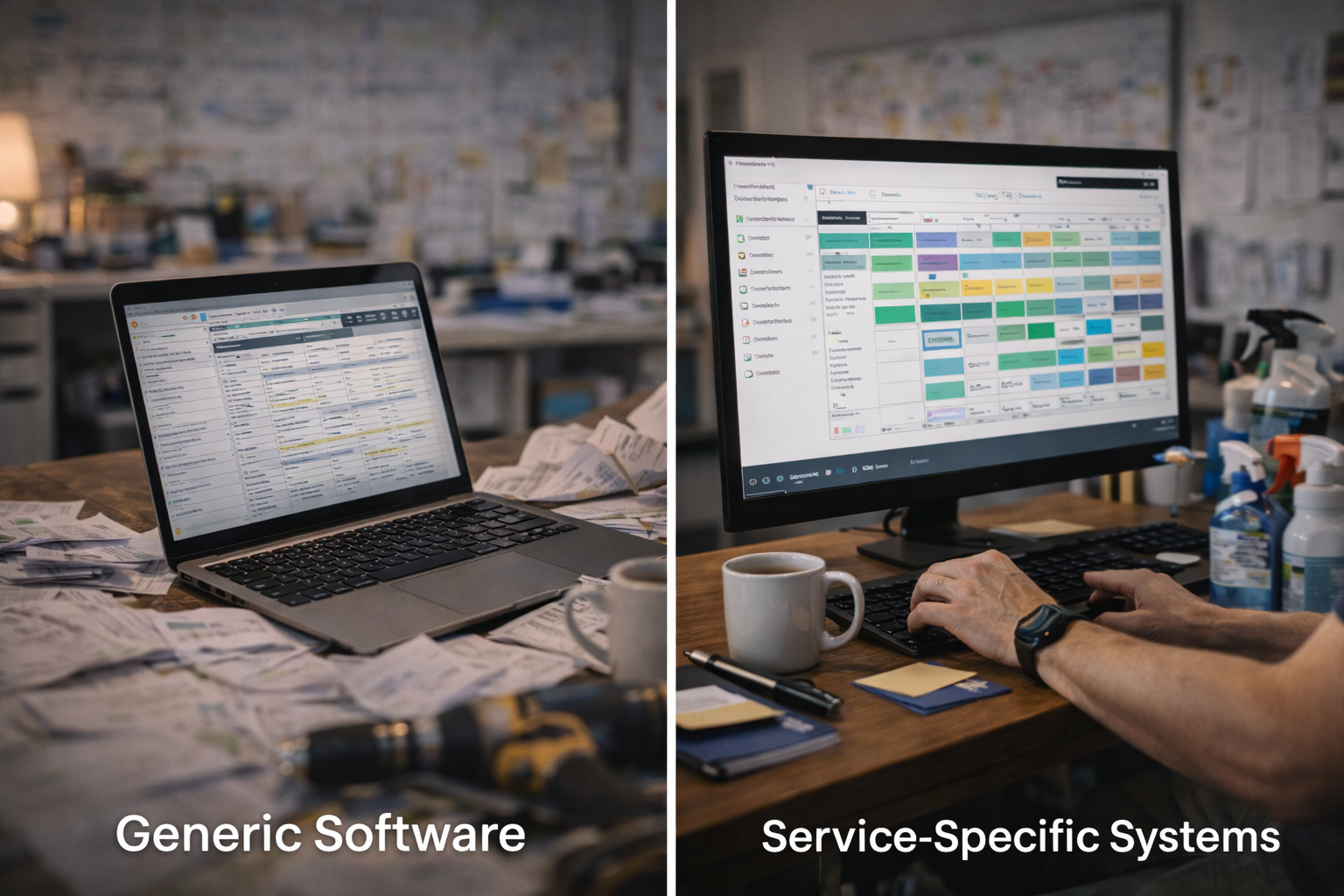
Generic Software vs Service-Specific Systems
Many service businesses invest in software and still feel disorganized.
Tasks take longer. Information is scattered. Mistakes continue.
The problem is rarely lack of tools.
It’s using tools that weren’t built for service operations.
Why generic software feels attractive at first
Generic software promises flexibility.
It’s often:
- Easy to start
- Affordable
- Familiar
- Designed for many industries
At low volume, this seems like a smart choice.
This usually becomes painful once
growth exposes weak systems.
Software that works for “any business” often works perfectly for none.
Where generic software breaks down in service businesses
Service businesses operate differently:
- Work happens in the field
- Schedules change daily
- Jobs have states, not just tasks
- Payments depend on completion
- Teams need real-time visibility
Generic tools don’t understand these realities.
They require workarounds instead of flow.
🧠 Quick reflection
Does this describe how your business feels right now?
The hidden cost of adapting generic tools
Adapting generic software usually means:
- Extra manual steps
- Duplicate data entry
- Side conversations to clarify status
- Owner intervention to connect systems
Over time, the tool adds friction instead of removing it.
This shows up later as
hidden operational costs.
What service-specific systems do differently
Systems designed for service businesses:
- Follow the lifecycle of a job
- Connect scheduling, execution, and billing
- Make job status visible by default
- Reduce dependency on memory
- Support teams working remotely
They don’t try to do everything.
They do service operations well.
A decision pattern many owners recognize
A business starts with generic tools and adapts constantly.
As volume grows, complexity explodes.
Eventually, the owner realizes:
the problem isn’t training people better —
it’s using the wrong type of system.
Choosing software is not a technical decision.
It’s an operational one.
Service businesses that choose systems designed for how they actually work
gain clarity, consistency, and room to grow.
The right systems support
scalable service operations.
🔍 Business Diagnostic Wizard
Identify hidden operational and financial losses in your service business.
Run a free diagnosticTurn these ideas into real results.
Diamond Operations Pro helps you organize your schedule, team, and finances in one place. More time, less stress.
Related posts
Why Your Service Business Feels Easy at First (And Why That Won’t Last)
Many service businesses feel under control at the beginning, but that sense of ease hides problems that surface as soon as volume increases.
You Just Opened Your Service Business — And Everything Depends on You
Most service businesses start with excitement, but quickly become fragile because every decision, message, and job depends on the owner.
Why 2025 Felt Exhausting for Service Business Owners (And What 2026 Needs to Look Like)
Why many service business owners ended 2025 exhausted despite staying busy—and what needs to change in 2026.