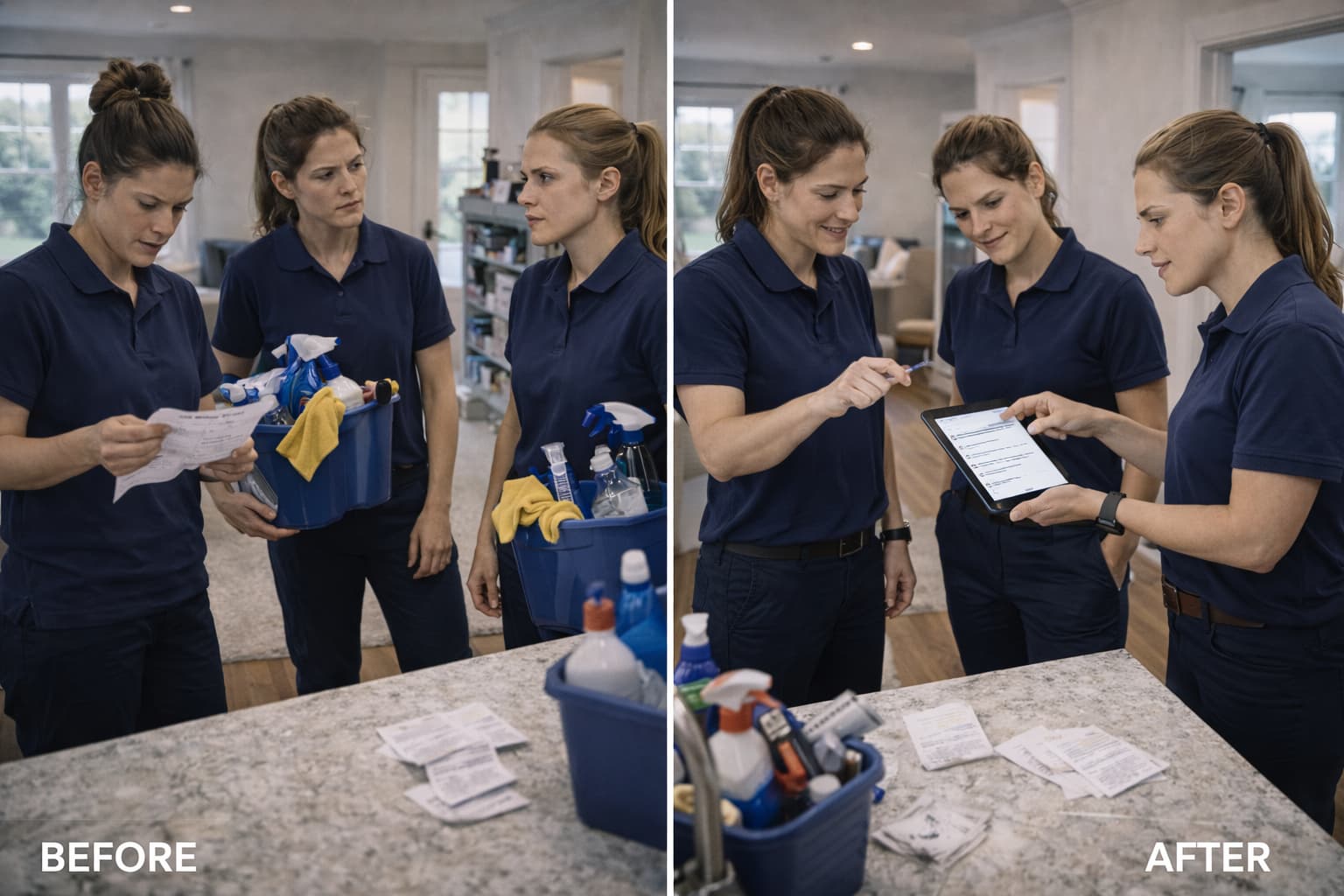
A daily operations checklist for your cleaning business
Use one opening, mid-day and closing routine to review assignments, access, changes, completion evidence and billing handoffs.
THE SHORT ANSWER
A useful daily checklist reviews exceptions before they become missed commitments. Open the day by checking coverage and access, review changes while crews are working, and close by matching completed jobs with evidence and the next billing action. Every unresolved item needs a person and a due time.
What you’ll take away
- Check readiness before dispatch, not after a crew reaches the property.
- Review changed work during the day instead of sending repeated status messages.
- Keep “work completed” separate from “invoice ready” and “paid.”
In this guide

A cleaning checklist describes the work inside a property. An operations checklist describes whether the company is ready to deliver that work and close the record afterward. They serve different purposes.
Use this proposed routine as a starting point and adapt it to your service agreements, team size and property rules. It is an operating tool, not a safety or compliance checklist.
Before the first visit
Review today’s jobs as a group before checking them one by one:
- Is each visit assigned to an available, appropriately trained person or crew?
- Do planned durations and travel fit the promised windows?
- Are access instructions, contact details and approved scope current?
- Are required supplies and equipment available?
- Are any properties or tasks waiting for clarification?
A missing key or unknown access code is an unresolved action, not a note to discover at arrival. Give it an owner and a deadline before the crew leaves.
During the working day
Review exceptions at a practical interval for your operation: absences, late arrivals, new requests, access failures and scope changes. A supervisor should be able to identify which change threatens the next commitment.
Hypothetical example: a first visit runs longer because the property condition differs from the estimate. Record the difference, obtain any needed approval and check the impact on later jobs. Changing only the calendar block leaves the next crew or office colleague without the reason.
Use a capacity check before accepting replacement work or moving a visit to another team. Availability is more than an empty calendar slot.
Before closing the day
Compare the list of scheduled jobs with the list of completed, rescheduled, cancelled and unresolved jobs. For each completed visit, confirm scope, required evidence, exceptions and the next billing step.
The person who cleans does not necessarily have to prepare the invoice. The handoff must make clear who does, what they need and when the job becomes ready for that action. See what to record after a job.
Keep the checklist short and accountable
A useful row has a check, a reason when it fails, a responsible person and a due time. Avoid adding a new checkbox for every isolated incident; improve the underlying instruction when several incidents share a cause.
Review a small sample weekly. If people tick every box but the same access and billing problems continue, the checklist is recording activity rather than controlling the handoff.
Common questions
Who should own the daily checklist?
Assign one coordinator and a backup. Team members provide job evidence, while the coordinator keeps the exception list and next actions current.
Does every job need photographs?
Use the evidence required by the service and customer agreement, with appropriate privacy controls. More photographs are not automatically better evidence.
Sources & context
- Cleaning industry safety resources · OSHA
Context on industry hazards. This DOP operations guide does not replace safety training or establish regulatory compliance.