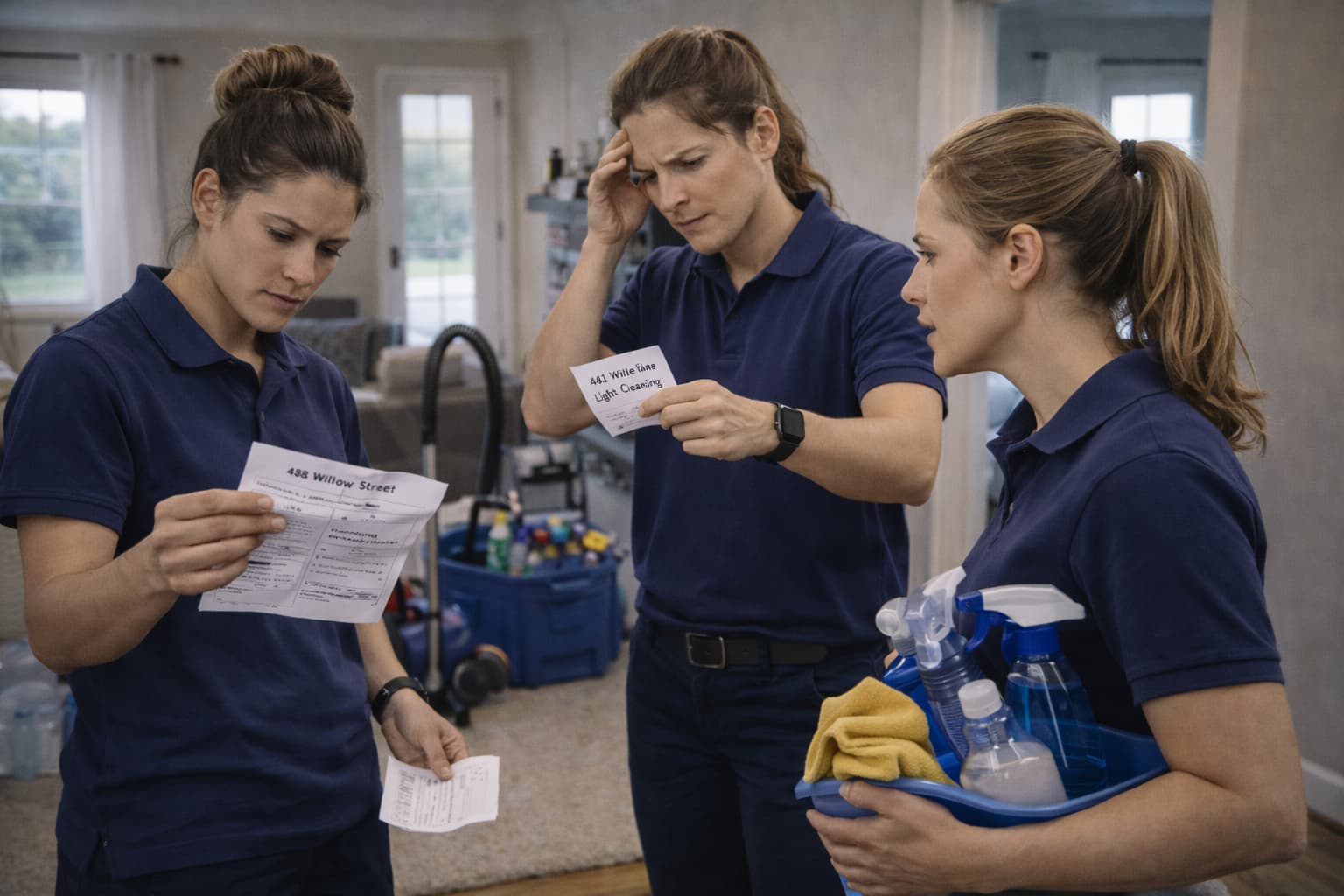
Evaluate the real cost of manual dispatching
Measure coordination work, route disruption and missed handoffs before deciding whether dispatching software fits your operation.
THE SHORT ANSWER
Evaluate dispatching software against a measured coordination problem. Record the time spent assigning work, handling changes and reconstructing job information, then compare that baseline with a small workflow test. Software cost alone does not show the total cost of changing a dispatch process.
What you’ll take away
- Measure administrative work and service disruption separately.
- Include configuration, training and ongoing ownership in the comparison.
- Test one ordinary route and one exception before committing.
In this guide

Manual dispatching can be appropriate for a simple operation with a stable team and clear customer commitments. It becomes difficult when changes arrive faster than the current process can keep everyone aligned.
The question is not whether every cleaning company needs dispatch software. It is whether a specific tool improves a problem you have actually observed.
Build a dispatch baseline
For a representative period, record time spent creating assignments, checking availability, finding access information, updating crews and resolving schedule conflicts. Keep rework, travel disruption and missed billing separate from administrative handling time.
Note who performs each activity. Owner time is still a resource even when no separate administrative wage appears in the job cost.
Compare the complete change cost
Include the subscription, setup, data cleanup, training, integration requirements and a named process owner. If a tool creates a second schedule that must be copied manually, count that ongoing work too.
Hypothetical comparison: a team spends 25 minutes per day reconstructing changes. At 20 comparable working days, that is 500 observed minutes. It is not automatically 500 minutes saved by buying software; a test must show which work disappears, which remains and which new tasks are introduced.
Test a normal day and an exception
Use a real, sanitized route to check assignment, access, duration, travel and crew communication. Then simulate an absence or an extended first visit. Ask whether the office and field team can identify the current plan without a second private conversation.
Check the handoff to completion and billing. Dispatch is part of a job’s lifecycle, not an isolated map view.
Decide with a small set of outcomes
Compare handling time, unresolved exceptions, commitments met and record completeness. Document limitations such as a smaller sample or a quieter week.
Use the capacity check to define confirmation rules and the tracking cost log to evaluate observed incidents. Choose the tool only after the workflow, adoption and operating cost make sense together.
Common questions
Is manual dispatch always inefficient?
No. A small stable operation may handle it well. Evaluate the coordination load and failure pattern instead of assuming software is always necessary.
What should a software trial prove?
It should prove that your team can handle an ordinary route and a realistic exception with reliable data, acceptable effort and clear ownership.